Web cookies (also called HTTP cookies, browser cookies, or simply cookies) are small pieces of data that websites store on your device (computer, phone, etc.) through your web browser. They are used to remember information about you and your interactions with the site.
Purpose of Cookies:
Session Management:
Keeping you logged in
Remembering items in a shopping cart
Saving language or theme preferences
Personalization:
Tailoring content or ads based on your previous activity
Tracking & Analytics:
Monitoring browsing behavior for analytics or marketing purposes
Types of Cookies:
Session Cookies:
Temporary; deleted when you close your browser
Used for things like keeping you logged in during a single session
Persistent Cookies:
Stored on your device until they expire or are manually deleted
Used for remembering login credentials, settings, etc.
First-Party Cookies:
Set by the website you're visiting directly
Third-Party Cookies:
Set by other domains (usually advertisers) embedded in the website
Commonly used for tracking across multiple sites
Authentication cookies are a special type of web cookie used to identify and verify a user after they log in to a website or web application.
What They Do:
Once you log in to a site, the server creates an authentication cookie and sends it to your browser. This cookie:
Proves to the website that you're logged in
Prevents you from having to log in again on every page you visit
Can persist across sessions if you select "Remember me"
What's Inside an Authentication Cookie?
Typically, it contains:
A unique session ID (not your actual password)
Optional metadata (e.g., expiration time, security flags)
Analytics cookies are cookies used to collect data about how visitors interact with a website. Their primary purpose is to help website owners understand and improve user experience by analyzing things like:
How users navigate the site
Which pages are most/least visited
How long users stay on each page
What device, browser, or location the user is from
What They Track:
Some examples of data analytics cookies may collect:
Page views and time spent on pages
Click paths (how users move from page to page)
Bounce rate (users who leave without interacting)
User demographics (location, language, device)
Referring websites (how users arrived at the site)
Here’s how you can disable cookies in common browsers:
1. Google Chrome
Open Chrome and click the three vertical dots in the top-right corner.
Go to Settings > Privacy and security > Cookies and other site data.
Choose your preferred option:
Block all cookies (not recommended, can break most websites).
Block third-party cookies (can block ads and tracking cookies).
2. Mozilla Firefox
Open Firefox and click the three horizontal lines in the top-right corner.
Go to Settings > Privacy & Security.
Under the Enhanced Tracking Protection section, choose Strict to block most cookies or Custom to manually choose which cookies to block.
3. Safari
Open Safari and click Safari in the top-left corner of the screen.
Go to Preferences > Privacy.
Check Block all cookies to stop all cookies, or select options to block third-party cookies.
4. Microsoft Edge
Open Edge and click the three horizontal dots in the top-right corner.
Go to Settings > Privacy, search, and services > Cookies and site permissions.
Select your cookie settings from there, including blocking all cookies or blocking third-party cookies.
5. On Mobile (iOS/Android)
For Safari on iOS: Go to Settings > Safari > Privacy & Security > Block All Cookies.
For Chrome on Android: Open the app, tap the three dots, go to Settings > Privacy and security > Cookies.
Be Aware:
Disabling cookies can make your online experience more difficult. Some websites may not load properly, or you may be logged out frequently. Also, certain features may not work as expected.
An introduction to popular music and diversity in America: jazz, blues, Top-40 pop, rock, hip-hop and other genres. Musicians and their music studied in the context of twentieth-century and contemporary American society, emphasizing issues of race, gender, class, and resistance. No prior musical training or knowledge required.
In the honors section students will have the opportunity to lead a discussion of one of the reading assignments from the primary-source materials text and present and discuss “My Favorite Pop-Song.” Honors students will also have an enhanced writing assignment on a topic of their choosing.
Origin, nature, and function of myth in the literature and art of Greece and Rome and the re-interpretation of classical myth in modern art forms. Taught in English. The honors section of CAMS 1103 will feature the opportunity to engage in a unique activity only for honors students, which will greatly enhance your learning in classical mythology. You will have the chance to discuss the honors project, which is a collaborative interpretive paper on the cultural treatment of one of the most important Greek myths, the story of the House of Atreus, in a small online discussion group with Professor Travis and the rest of the honors section, with whom you are collaborating on the paper. (You will be graded on your contribution, and not on the group’s final product, so you will be evaluated only on your own work.)
Prerequisite: ENGL 1010, 1011, or 2011
Instructor: Sean Forbes
This workshop will introduce methods of writing poetry and prose. The first half of the course will focus on poetry, and the second half will focus on fiction. Students will have the chance to produce and revise work, to hone critical reading skills, to learn the tools with which they can critique the work of others, and to become careful editors of their own work. Students will be expected to read and write on a daily basis. Active participation is mandatory.
ENGL 2401-007: Poetry
Prerequisite: ENGL 1010, 1011, or 2011
Instructor: Jonathan Hufstader
How to read, hear, see, understand, enjoy, interpret, think about, talk about, and write about poems. Come prepared to do all these things actively in class. Two papers, midterm, final.
The sociology department invites Honors students to consider taking one or more of their graduate courses. With your advisor’s approval, graduate courses may be included in your Honors Final Plan of Study for graduation. They also count toward your Honors participation requirements.
SOCI 5201 THE LOGIC OF SOCIAL RESEARCH
Bandana Purkayastha
How do social scientists decide which methods enable them to find the best answers to their research questions? How do different epistemologies lead to diverse methodological frameworks and different methods of social enquiry? This course will provide you with the tools to understand and weigh a variety of methodologies and methods of social inquiry. You will develop the ability to critically assess research methods. I will expect you to design your own research proposal and ensure it is consistent with the ethical standards of research required by our university.
SOCI 5231 QUALITATIVE RESEARCH I
Claudio Benzecry
How do sociologists observe social life? How do they gather evidence through conversation and observation? What is the difference between scientific evidence and anecdotal evidence or opinion? What constitutes rigorous empirical qualitative research? This course aims to answer these, and other questions. To do so the course will familiarize students with both classic and contemporary ethnographies; it will acquaint studies with the methodological tenets of ethnography, life stories, in-‐depth interviewing and visual sociology; it will consider theoretical and epistemological issues in ethnographic research and will put some of the data production techniques into practice. Looking at sources, focusing especially on the fit between evidence and analysis, the course will intertwine questions about the theoretical and practical dimensions of practicing qualitative sociology. Theoretically, we will consider questions such as the following: What is “qualitative” research? What are the roles of induction and deduction? Can qualitative research verify hypotheses, or only generate them? Practically, we will consider questions such as the following: What is a good key informant? How does one write good fieldnotes? What is snowball sampling? What is the difference between good and bad ethnographic evidence? How many interviews are enough? In considering multiple means of observation, students will develop an analytic vocabulary with which to critique social inquiry. Written assignments are exercises in data collection and analysis, and some of each week’s class time will address the very practical concerns that researchers must consider when conducting any study. The skills gained in this course should be applicable to an extended research project, either individually or in collaboration with others.
SOCI 5251 CORE THEORISTS
Matthew Hughey
For better or worse, contemporary sociology rests largely on a foundation of concepts, observations, and procedures developed by a variety of European and North American thinkers in the eighteenth, nineteenth, and twentieth centuries. In the eighteenth century, sociology was not yet institutionalized as a distinct point of view or profession. Rather, social reflection and observation were styles of thought within philosophy and letters more broadly. By the late nineteenth and early twentieth century, however, a number of thinkers began to identify social science—if not yet sociology in particular—as a distinctive enterprise with unique procedures, concepts, and theoretical points of view. Any understanding of sociological projects in the contemporary period thus rests on a comprehension of the origins and outlines of the field as they formed in these contexts. By the same token, the ideas, attitudes, and terms propagated by thinkers from the Enlightenment, the Romantic Age, and the Industrial Era, and the sociological theories built on them, provide enduring resources for, as well as origins of, the self-‐concept of the modern world. These are the terms of our self-‐understanding and referents of our sociological discourses. A central question is whether, and in what ways, they still contribute to our understanding of the world in which we live and the ways we practice sociology.
SOCI 5425 TOPICS IN STRATIFICATION AND INEQUALITY
Jeremy Pais
This course focuses on the social stratification processes that affect people’s life chances over life course—from childhood to old age. Understanding life course processes of stratification will require students to develop deeper analytical understandings of the social stratification system, to theorize ways in which this system shapes different life trajectories, and to recognize the system itself is a product of series of life-‐course status distinctions. We will focus on a range of topics from the early formation of values, attitudes, and aspirations during the formative years; educational opportunities and human capital acquisition; the effects of local-‐labor market conditions on young adults as they transition to adulthood; intragenerational mobility; poverty exposure and the process of “aging off the street”; intergenerational transmissions of status attainment; wealth accumulation; and health and quality of life issues among the elderly and disabled. This course will also provide supplemental material for students taking a social stratification comprehensive exam.
SOCI 5605 GENDER AND SEXUALITIES
Mary Bernstein
This course explores the social organization, construction, and politics of sexualities with a particular focus on lesbian, gay, bisexual, transgender, and queer (lgbtq) experiences and the intersection of sexualities, gender, race, age, and class. We look at how institutions, identities, and discourses interact with, are regulated by, and produce sexual meanings. We examine the ways in which sexuality and desire are constituted through the state and the political economy as well as the ways in which sexuality serves as an axis of domination. Other topics include sexuality and immigration, sex work, transnational sexuality, sexuality and masculinity, and adolescent sexuality.
SOCI 5612 FEMINIST THEORY AND SOCIAL SCIENCE
Nancy Naples
This course introduces you to the intellectual background and contemporary context for diverse feminist theoretical debates in the social sciences. We will explore these debates with reference to transnational and intersectional feminist perspectives on politics, science, socialization, sexuality, economics, postmodernism, postcolonialism, and globalization. Group discussion is the primary format for the course. I will offer background information and provide direction for the discussion, but we will work together to create an atmosphere that maximizes participation.
SOCI 5801 POLITICAL SOCIOLOGY
Ruth Braunstein
This course introduces graduate students to the sociological study of politics. More specifically, it will investigate the ways in which political institutions, processes and norms shape (and are shaped by) a variety of social and economic inequalities. We will explore this general theme by reviewing important theoretical debates about power, political struggles and the state; as well as classical and contemporary scholarship on welfare state development and the politics of social policymaking. We will pay particular attention to questions about the unique character of the American welfare state, the gendered dimensions of social policy, and the historical and enduring ways in which race, immigration and cultural distinctions between deserving and undeserving groups shape (and constrain) social policymaking. Throughout, we will consider the theoretical and methodological issues that drive major debates within this subfield. Although this course is open to students of all interests and backgrounds, it is particularly designed to provide a conceptual and theoretical foundation for graduate students who are thinking of taking a comprehensive examination in the field of political sociology and/or conducting original research that relates to this field.
SOCI 5895 INVESTIGATION OF SPECIAL TOPICS: CONTESTING DEVELOPMENT
Manisha Desai
In this seminar we will examine the history of International Development as theory and praxis, from modernization to its current formulation as a rights based discourse in the era of neoliberal globalization. Along the way we will study how race, gender, indigeniety, sexuality, and disability became embedded in its re-‐imaginings and the current, critical struggles around and against development, post-‐development, rights and justice.
SOCI 6203 QUANTITATIVE RESEARCH II
Simon Cheng
SOCI 6203 is the second course in sociology’s graduate sequence in applied statistics. The first course, SOCI 5203, deals with models in which the dependent variable is continuous. These include the linear regression model, seemingly unrelated regressions, and systems of simultaneous equations. SOCI 6203 deals with regression models in which the dependent variable is limited or categorical. Such models include probit, logit, ordered logit, and Poisson regression, among others. The course assumes a good working knowledge of the linear regression model for continuous variables, as well as elementary knowledge of matrix algebra.
A new Honors version of BIOL 1107 will be offered once a year, starting in Fall 2014. All Honors lab sections are attached to a single Honors lecture. Students who complete the course with a B- or better will earn 4 Honors credits on their transcripts. Students will no longer take the BIOL 1109 Honors seminar concurrently with BIOL 1107.
Honors credit for BIOL 1108 will still be earned by taking the BIOL 1109 Honors seminar concurrently with any BIOL 1108 section. Students’ transcripts will show 4 non-Honors credits for BIOL 1108 and 1 Honors credit for BIOL 1109. Starting in Fall 2014, students who earn a B- or better in BIOL 1108 and BIOL 1109 will be treated as if they had earned 4 Honors credits toward Honors participation requirements and/or Sophomore Honors. BIOL 1108+1109 may also be used as the 3 additional Honors credits at any level required for graduation as an Honors Scholar, but it will not fulfill the “depth” requirement (3 credits in an Honors graded class).
These changes do not affect students who completed BIOL 1107 + 1109 and/or BIOL 1108 + 1109 prior to Fall 2014. These students will still be treated as if they had earned 5 Honors credits for each.
Quian Callender, Honors student, class of 2016, Health Care Management major, Public Policy minor
My favorite part of being a Husky includes the ability always meet new people from all walks of life and across all interests. In addition to UConn’s size, tight communities and close, lasting relationships with peers form. There’s a huge sense of pride that’s apparent everyday especially during UConn traditions such as Homecoming Week and athletic games. As a UConn student, you will have the opportunity to pursue any of your interests through the Honors Program, clubs, organizations, volunteering opportunities, internships, and research.
Sarah Levine, Honors Student, Class of 2016, Communication and Journalism Major, Spanish Minor
My favorite thing about UConn is its size and diversity. In such a large school, I interact with all kinds of people every day. There are always other people who are also interested in things that you are interested in- just look at all of the clubs, sports, and activities we have on campus. Through these things, students can join tighter communities that make a 17,000-student university feel like home. Personally, the thing that helped me transition into college the most was being a part of the Honors community. Faculty and advisors are always around to answer questions or just talk, and I loved living with other honors students with whom I shared similar interests and classes. From the minute I stepped onto campus, everyone has been welcoming and brimming with campus spirit. Everyone is proud to be a Husky- especially at all of our many sporting events! Go Huskies!
Abby Raynor, Honors Student, Class of 2017, Molecular and Cell Biology Major, Pre-Med Track, Spanish Minor
I am a freshman here in the University of Connecticut Honors Program. I intend to major in Molecular and Cellular Biology and minor in Spanish, and I am a part of UConn’s pre-med program. On campus, I am involved in numerous clubs and organizations like Pre-Med Society, Global Brigades and the UConn Club Swim Team. I am also an active member of the Honors community by volunteering at many recruitment events as a HIPS Student coordinator, and I’m currently training to be a student facilitator in the freshman seminar course each first-year Honors student is require to take. In my free time I love to attend all UConn sporting events, especially basketball, and show off my Husky pride!
Holly Chase, Honors Student, Class of 2017, Health Care Management Major, Neuroscience Minor
My favorite part about being a Husky is the limitless opportunities that are available to each student. Your college experience is reflective to the work you put into it, and I believe engaging in campus events, clubs, and organizations is the best way to begin! In addition to volunteering for HIPS, I play Club Field Hockey, am a member of the Honors in Business Association, and consider myself an avid basketball fan! Through these outlets, I have made fantastic friends and gained peer connections that have positively shaped my direction as a student. Get involved and have fun! Bleed Blue!
Vincent Pistritto, Honors Student, Class of 2018, Chemistry and Music Majors
Being a Husky means many things-either you’re pulling a sled in the Iditarod, you’re wearing a winter coat all year round, or you go to UConn. Coming from a small town in western Connecticut, everybody knows that when you’re a Husky, it only means one thing-you go to UConn. It is that sort of recognition and pride that sets UConn apart. You can meet so many different people and engage in truly thought provoking study while at the University. As a member of the Honors Program, you have a smaller family nestled within the larger student body. This gives you a small campus feel at a larger university. In addition, there is a wide variety of extra-curricular activities to get involved with which will enrich your college experience. I hope you all will come to UConn and get to experience first-hand what a special place Storrs, Connecticut truly is. Go Huskies!!!!
Kyle Terracciano, Honors Student, Class of 2018, Chemical Engineering Major, Mathematics Minor
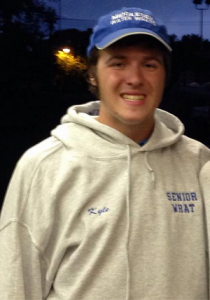
I am a freshman in the University of Connecticut Honors Program. I am currently majoring in Chemical Engineering with a minor in Mathematics. On campus, I am a member of the American Institute for Chemical Engineers and I volunteer for the Northeast Regional Science Bowl, one of the largest events of its kind in the country Over the summers, I coachcompetitive swimming in my hometown of Middlesex, NJ. I stay involved with the Honors Program by helping organize events for prospective honors students as a HIPS Student coordinator. I am also currently in training to be a UNIV 1784 facilitator for next year. What I love about UConn is all of the amazing academic opportunities provided for students and the abundance of school spirit. Go UConn!
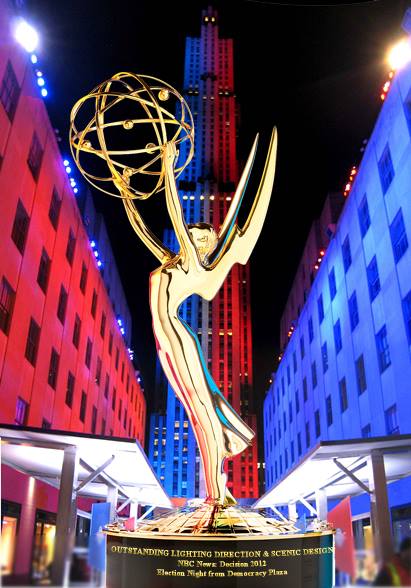
“When I first started working in lighting, I always had my sights set on winning a Tony Award on Broadway,” said Dan Rousseau ’08 (FNAR-Honors). Now, just five short years after graduating from UConn with an Honors degree in Design/Technical Theater, Dan has established himself as a television lighting director in New York City. He also has his first Emmy.
“Decision 2012 – Election Night Coverage from Democracy Plaza” wins an Emmy. Photo: Lighting Design Group. (Courtesy of Dan Rousseau)
Dan’s love for the stage began as a child singing in local musical choirs. He eventually gravitated backstage where he felt the real magic happened, with lighting and set design. “It’s the ability to heighten scenes and push emotions,” said Rousseau, “just through creating an image that can resonate in audiences’ minds well after the curtain comes down.”
As an Honors student in the School of Fine Arts, Dan encountered numerous mentors who helped him develop his expertise. Professors Jim Franklin and Jeff Davis “shaped my design skills,” said Rousseau. Professor Tim Hunter taught him not just design, “but the business side of being a designer,” he said. “And the late David Taylor showed me the world of theatre consulting.” Dan holds the entire Department of Dramatic Arts in high esteem. “Faculty and staff were constantly supporting and inspiring me to do more,” said Rousseau. This included taking graduate-level design coursework during his undergraduate degree.
While at UConn, Dan worked as an assistant lighting designer with the Connecticut Opera and was involved with various productions at the Connecticut Repertory Theatre (CRT). His experience at CRT served as the foundation for his Honors thesis: “Lighting Design for Pentecost.” As part of this project, he created a comprehensive design procedural guide that included his “early design process, production photos, and critiques and reviews,” said Rousseau. “It was my goal to provide a document that showcased the work that went into designing that show.”
After a short stint as a freelance theatre designer and a call to a UConn alumna, Dan was contacted by the Lighting Design Group, the largest television lighting design company on the east coast. He was hired as an assistant lighting director and soon after moved to New York City. His first assignment was with CNN, and in less than two years Dan was promoted to lighting director for “Anderson Cooper 360.” Now five years after his UConn graduation, Dan and his assistant oversee several shows for CNN, including “Quest Means Business,” “Piers Morgan Live,” and “Anderson Cooper 360,” as well as additional special projects.
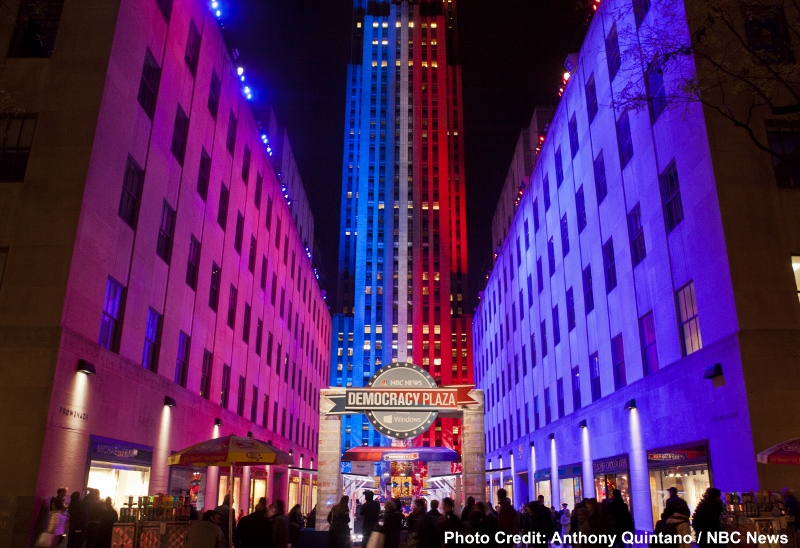
In 2012, Dan was offered a very special assignment: Decision 2012 – Election Night Coverage from Democracy Plaza. The team was asked by NBC to bring breathtaking patriotism to Rockefeller Plaza for Election Day 2012. “My main job was to make sure it was installed according to plan,” said Rousseau. However, the arrival of Super Storm Sandy made that task a true challenge.
Emmy-winning “Decision 2012 – Election Night Coverage from Democracy Plaza” lighting display.
“Sandy slowed us down with the load in, but we made up the time working around the clock leading up to the big night,” said Rousseau. Technological advances in lighting served as an important part of the project. “We had to keep a low power footprint because NBC and Rockefeller Plaza didn’t want to bring in large generators to power the sight. Robotic moving lights were used to paint 30 Rock in the red, white, and blue that could be seen all over. LED [lights] provided a low power option to highlighting smaller features of the plaza,” he said. “It used to be that if you wanted multiple colors washing a wall, you needed independent lights with color in front of them. Add that all up and it can be about 5,000 watts! Now, with a single 10 watt [LED] light, you can have every color of the rainbow,” said Rousseau.
Production for Democracy Plaza began on Election Day at 7 a.m. with “The Today Show” and continued live into the evening, as millions at home and a packed plaza awaited the results. In addition to the lighting installation, “I also was stationed down at ice rink level for a mini studio where exit polls were reported on an 80-inch touch screen monitor overlooking the ice. At times we were even on the ice!” said Rousseau. “The only way to describe such an event would be to call it the Olympics of broadcast.”
Almost a year after the Election Night production, the News & Documentary Emmy Awards were held in New York City. On October 1, 2013, while overseeing the lighting for a “Piers Morgan Live” special audience edition, Dan received the great news. “I was following the awards as they were announced on the Twitter page, and when I saw the tweet about Democracy Plaza winning the Emmy for “Outstanding Lighting Direction and Design,” I was ecstatic and shouted ‘YES!,’ scaring my co-worker who was in the room,” said Rousseau. Dan waited until a commercial break to call his parents.
While Dan still has a passion for the stage and the dream of a Tony, “winning the Emmy was unexpected and wasn’t a goal I had set for myself,” he said. “But now that I have, it has moved my sights on to winning the next.”
Return to the Spring 2014 issue of the Honors Alumni eNewsletter
Jane (Presnick) Lyon ’78 (NURS-Honors) has ties to UConn that run deep. This Honors Scholar began her nursing career with her education at UConn, and she learned many lessons at Storrs, ones that have helped her maintain a sense of harmony in all aspects of her busy life.
Jane followed in her siblings’ footprints when she attended UConn, and it was here she met her husband, David ’78 (CLAS), ’81 (BUS), in McMahon Hall on October 14, 1977, during a Yankees and Red Sox playoff game. Despite a difference in team loyalties, they married five years later and began their family. They had four boys, who all eventually attended UConn as well: Michael ’08 (CLAS); Robert ’11 (CLAS), ’14 (LAW); David ’14 (CLAS-Honors); and William ’16 (BUS).
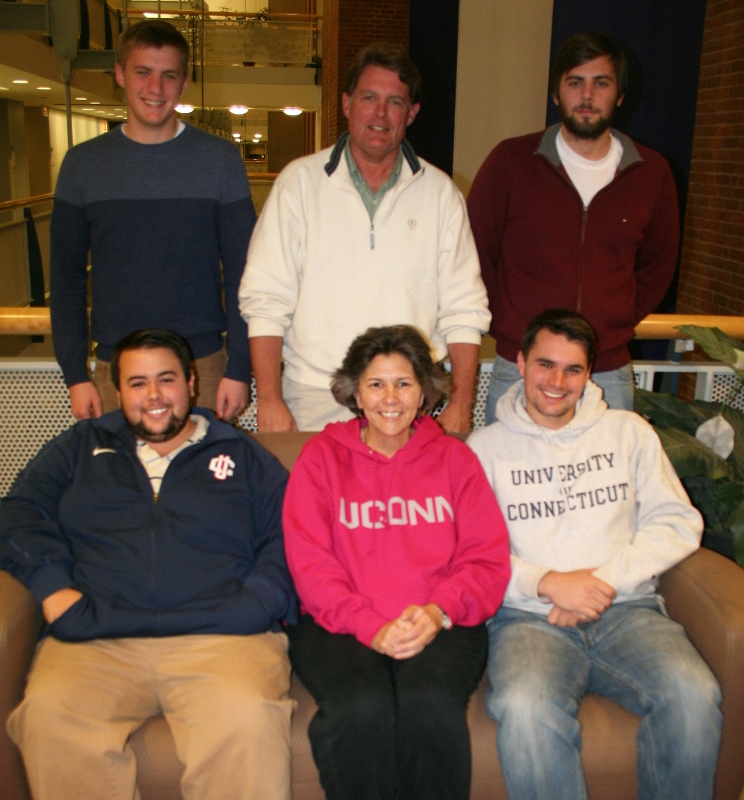
Seated from left: Robert D. Lyon ’11, ’14; Jane Presnick-Lyon ’78; and Michael D. Lyon ’08. Standing from left: William C. Lyon ’16; David B. Lyon ’79, ’81; and David B. Lyon, Jr. ’14
Jane’s family was the impetus for her career in nursing. Her mother was a nurse as were her aunts. But her mother foresaw changes coming to the profession and encouraged Jane to earn a formal college degree in the field. “[My mother] was a diploma graduate (St. Raphael’s in New Haven) but knew that the future of nursing was the baccalaureate and encouraged me to get my BSN,” said Lyon. “I am forever grateful to her for that advice.”
When Jane came to UConn as an Honors student, the Honors Program was still relatively new, though its ranks were growing. “I believe our graduating class in the School of Nursing had 106 students in 1978 with two of us graduating from the Honors Program,” she said. Jane fondly remembers the structured education of the UConn Nursing program, the clinical on-site experiences her senior year, and the exceptional faculty. “In addition to the coursework,” said Lyon, “the time management, responsibility, and professionalism learned at UConn have served me well.”
Before she even graduated from UConn, Jane was already building her resume and gaining experience at an institution that would eventually become a large part of her career. “Between my junior and senior year, I worked as a Student Trained Aide at Waterbury Hospital,” she said. “That auspicious beginning led to a 35-year affiliation with Waterbury Hospital. I was hired as a graduate nurse in 1978 in the float pool. Being in the float pool was great because I learned about many different areas of nursing. Every night was different!” During the course of her nursing career, Lyon continued to challenge herself. She has worked in surgical intensive care, post-critical care, and cardiac care, ranging from a charge nurse to a nursing supervisor, and even worked briefly as a nursing instructor.
The option of a per diem schedule was another reason why Jane chose nursing. This scheduling system afforded Lyon the flexibility “to accommodate my other passion—raising a family,” she said. Jane has been able to effectively blend both career and home life for her four sons. She served as PTA president, member of the Soccer Club Board of Directors, registrar for the Soccer Club, coach for her sons’ youth baseball teams, and Merit Badge Counselor for the Boy Scouts. “The Honors Program taught me to push myself and not say ‘no’ to a challenge,” she said. “I took on all of these tasks wondering how I would get it all done, but the lessons learned at UConn about working hard have paid off.”
In 2007, when her boys were mostly grown or already off to college, Jane focused her attention again on nursing, and she accepted a position as nursing supervisor at UConn’s Health Center, where she remains today. Her job requires her to closely monitor staff levels and problems across 14 units, address policy and procedural questions for medical staff, and assign beds to patients if the shift need arises, she said. It also rekindles her link to UConn, though it is safe to say that connection never went away.
The Lyon boys attended and watched UConn games throughout their childhoods, ate at the Dairy Bar, and wore UConn gear from infancy. Jane proudly admits to sending subtle hints to the children about attending UConn. “Our oldest son, Michael, was quite a good soccer player and we hoped he would play college soccer. He told us, ‘I’d rather go to UConn and not play soccer than go anywhere else and play,’” said Lyon. “Having my children attend UConn has been a wonderful experience. It was so comforting dropping them off as freshmen because it held such fond memories for me, and I knew they were going to have a wonderful four years.”
Her UConn connection does not end there. Jane and her siblings are also UConn donors, having established the Presnick Family Scholarship in honor of their parents, which is awarded to a junior nursing student. Jane gives of her time as well, at the School of Nursing’s annual “Postcards” event to offer advice to aspiring nurses and as a member of the alumni board.
“The UConn flag hangs proudly in front of our house whenever possible,” said Lyon, “but especially during the Final Four and whenever a son was accepted there.”
Return to the Spring 2014 issue of the Honors Alumni eNewsletter
Amy Nocton, B.A. ’92 (CLAS-Honors), M.A. ’93 (CLAS) became a teacher by chance. Once in the classroom, her love for the Spanish language inspired her students to love it as well. A small group of those students even followed her footsteps, becoming UConn Honors Scholars and educators, too.
Amy began taking languages classes in high school. Her father initially pushed her to Latin, but her teacher frightened her, she said. Amy wanted to study French, but her father convinced her to study Spanish, with the promise of a trip to Spain after two years. Amy’s competitive nature accepted the challenge, and at age 17 she went to Valencia for five weeks. Amy was completely immersed in the language there, and when she returned to the U.S., her skills had advanced one year’s worth of high school curriculum, said Nocton.
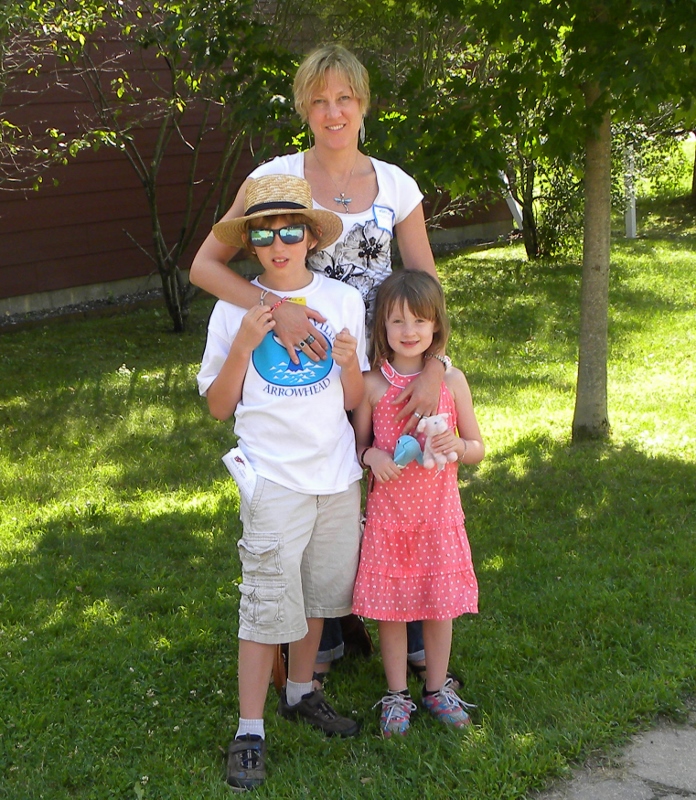
Amy Nocton with her children, Cormac and Elsa.
Spanish became her pursuit at UConn, woven in between history and literature courses in Latin American Studies. “Everything clicked,” she said. “It’s awesome when that happens.” She completed an Honors degree in Latin American Studies-Spanish, and also began taking coursework for her master’s degree in International Studies. At graduation she earned the Outstanding Academic Achievement Award for the Humanities and distinction as a University Scholar.
After college, Amy was awarded a Fulbright and went to Chile to prepare. However, shortly she learned the funding was pulled due to the economy, and she found herself without a job or any clear direction in life. She returned to the U.S. and applied for a childcare position she found in her local paper. The family initially intended to hire Amy as a home helper, but Amy’s Spanish skills filled a different need. The family’s father worked at the private Westminster School in Simsbury, Conn., and the school was looking for a new Spanish teacher. “I interviewed and was hired that day,” said Nocton. “I had never wanted to teach, but I ended up loving it.”
Amy spent three years in private school before transitioning to public school, and for the past 16 years she has taught at RHAM High School. Nearly a decade of her time there overlapped with her husband, Jason Courtmanche, B.A. ’91 (CLAS-Honors), Ph.D. ’06 (CLAS), who taught high school English. Their years at RHAM introduced the couple to many students, but some have specifically stayed with them: Hannah Mondrach, B.A.’12 (CLAS-Honors), B.A.’13 (CLAS-Honors), M.A.’14 (EDUC); Dana Lovallo, B.A./M.A. ’13 (EDUC-Honors); and Seana Marceau ’11 (CLAS).
Hannah graduated from RHAM in 2008 after having had both Amy and Jason as teachers. She credits the couple for her decision to choose the UConn Honors Program. “When I think of Amy and Jason and their approach to teaching and life, I think of grace and grit,” said Mondrach. “They put all they have into everything they do, but make it look so effortless.”
Dana was also encouraged by Amy and Jason to attend UConn Honors, and she felt prepared for the experience. “Amy’s Spanish ECE class gave me a huge glimpse of what a college-level course would be,” said Lovallo. “She challenged us to read literature that I actually encountered again at UConn,” she said. Lovallo was a 2008 graduate of RHAM and former student of both Amy and Jason as well.
Amy taught Hannah and Dana in their Early College Experience (ECE) Spanish courses, which are high school classes designed to introduce students to the rigor of college. “The high school students are truly getting a sense of what college-level classes are expecting,” said Nocton. ECE classes are different from the more well-known Advanced Placement (AP) courses high school students can also take for college credit. However, Amy noted that ECE credits are becoming more accepted by universities than AP credits. “AP is a snapshot,” said Nocton, “it’s just one day, it’s a test. [ECE] are courses that are credited, they are vetted by university personnel,” she said.
Hannah believes teachers such as Amy and Jason have unique abilities in the classroom. “They make you feel like, at the end of it, you did all of that hard work yourself, even though in the background they were working harder than anyone to help you succeed,” she said.
Becoming teachers
In many ways, the young women were becoming teachers through their close association with Amy and Jason. “My friends would joke that I was going to become ‘the next Señora Nocton,’” said Mondrach. Amy is inclined to agree. “Hannah is an extraordinarily talented linguist” said Nocton. “She studied Italian with me as well. She has a little box for Spanish and a little box for Italian, and never shall they meet.” Hannah studied Spanish and Italian literature as a UConn Honors student, but stayed an additional year to major in geosciences as well. Hannah is finishing up her education master’s degree this year at UConn with the intention of teaching STEM.
Amy inspired Dana as well, not just in her career, but also in her Honors thesis. Dana, who was hired in 2013 as an E.O. Smith High School Spanish teacher, completed a two-pronged Honors thesis project. She encouraged immersion programs for current college students by developing a marketing booklet for the Office of Study Abroad to promote the program she pursued: UConn in Granada. Dana also wrote a paper in Spanish that examined her survey research about the importance of immersion experiences for Spanish teachers, noting how Amy’s many overseas excursions enhanced her ability to teach, she said.
Hannah and Dana knew early on that education was their future, but another one of Amy and Jason’s students did not. Seana had Amy for ECE Spanish at RHAM, but she never formally took a class with Jason. He met her while on sabbatical to write his dissertation, when Seana began assisting the family after school as a mother’s helper. Once Jason returned to RHAM, “Seana had a habit of crashing my classes anytime she had a free period, and she became more like a co-teacher,” said Courtmanche.
Seana’s presence in his classroom was specifically important during his lower-level courses, classes where students were less interested in literature. “Seana would come in, and when we read…she’d take a part, I’d take a part, the students would take a part, and she and I would put effort into acting out the scenes, which provided a good example and motivation for the other students,” said Courtmanche.
Despite her obvious skill in the classroom, “[Seana] used to swear up and down she was not going to go into education,” said Courtmanche. “But she hung out with Amy and me—and all our friends are teachers… It got into her skin somehow, whether she wanted it to or not.”
At the start of her senior year at UConn, Seana was still adamant she was not going to teach, though she was majoring in Spanish and English. It was a year that almost didn’t happen. Personal issues nearly forced Seana to leave school, so Amy and Jason persuaded her to move in with them, and she would help around the house with chores and child care. But soon after she moved in to help take care of the family, Seana was struck head-on by a drunk driver. She was taken by LifeStar and survived, though she required a new kind of support from Amy and Jason, who assumed the caregiver role for her. “She didn’t even take an incomplete though,” said Courtmanche. “She finished the semester, made the dean’s list, and then in the spring semester finished up her senior year with me driving her around,” he said.
After graduating from UConn, Seana accepted a teaching job in southern Spain. She floated between various classrooms during her time there, teaching subjects as the need arose, such as physics and chemistry. “She was self-teaching herself to be able to teach the kids,” said Nocton. “Whatever they needed her to do.” Seana’s principal nominated her for a teaching award, which she won. The award led to a fellowship at Columbia’s Teachers College. Jason remembers Seana saying: “You always said I’d be good at teaching; you said the kids would love me, but you never said how much I would love them.”
These teachers’ lives, a generation apart, are linked by even the small details. In 2011, Amy—the woman who never intended to become a teacher—won the Teacher of the Year award from the ECE program. That was the same year Seana won the Spanish Distinguished Scholar Award from UConn. Dana received the same award the following year. Hannah graduated from UConn not just an Honors Scholar but also a University Scholar, as Amy did. And all four women found their love for teaching in a Spanish classroom.
Return to the Spring 2014 issue of the Honors Alumni eNewsletter
Bill DeWalt ’69 stepped down as Founding President and Director of the Musical Instrument Museum in Phoenix, Ariz., in May. During his six years there, he presided over every aspect of building the $250 million museum. He has returned to Pittsburgh, Pa., to head the local office of the Arts Consulting Group where he serves as a senior consultant.
1970s
Anne Levy Paluck ’73 is the personal librarian to the first cohort of students in the new Honors Program at Middlesex Community College in Middletown, Conn. Barbara Hastings ’75 is Director of Development at Fraser Woods Montessori School in Newtown, Conn. Jim Oleksiw ’75 was elected to the UConn Alumni Association National Board of Directors in June. He is currently serving on The UConn Club Board of Directors and past president of The UConn Club. Mark Romanoff, M.D. ’79, ’83 was named a finalist for 2013 Physician of the Year by the Charlotte Business Journal. Cited for work in preventing misuse of prescription medications. He is a founding member of the Advisory Board for the North Carolina Prescription Medication Database and a core faculty member for Project Lazarus (grant-based state-wide program teaching primary-care physicians the rational use of narcotics).
1980s
Vibha Miller ’83 earned her M.B.A. at NYU Stern after UConn. She and her husband Gregory (UConn Ph.D. 1987) have pursued non-profit careers in our nation’s capitol. Vibha is a board member of the Potomac Conservancy, a Girl Scout troop leader, and active in the McLean community. WETA is D.C.’s public television and classical music station, where Vibha leads Human Resources. Glenn Sarno ’89 was appointed to serve a three-year term as the Chair of the Committee on Private Funds of the New York City Bar Association. The committee, comprised of leading practitioners, addresses legal and regulatory issues affecting private equity funds, hedge funds, and other facets of the alternative asset industry. Glenn is a partner at Simpson Thacher & Bartlett. Charles Wynn ’89 received an R&D100 award on Nov. 8. These awards are given by R&D Magazine to the top 100 technology products of the year. This award is for an invention using photo-acoustic technology to detect explosives. Dr. Dan Zelazny ’89 was recently named head team physician for Marist College athletics.
1990s
Jason Courtmanche ’91 was awarded a Teaching Scholar award by the Institute for Teaching and Learning last spring, and was elected President of the Nathaniel Hawthorne Society, effective June of 2014. Shawn Fisher, B.A. ’91, M.A. ’93, has been active in the process of helping physicians and hospitals make the transition from a “fee-for-service” to a “fee-for-value” environment, focusing on helping improve quality of care, reducing costs, and improving the care experience. “It’s amazing to be on the proverbial front-lines of healthcare reform. We’re really making a difference.” Seth Jaffe ’91 was recently named the Acting General Counsel for the U.S. Office of Government Ethics. The U.S. Office of Government Ethics is responsible for setting a uniform ethics policy as well as interpreting ethics laws and regulations for the executive branch of the federal government. Seth graduated cum laude from Duke University School of Law in 1998. Carmela Townsend ’91 received her Doctor of Nursing Practice degree on September 6, 2013, from the MGH Institute of Health Professions. Dr. Townsend’s capstone project, “Describing the Transition to Practice Experience of the Clinical Leadership Collaborative for Diversity in Nursing Baccalaureate Graduates,” was successfully presented to her faculty, colleagues, and friends. She looks forward to preparing a manuscript for publication. Ken Whittemore ’91 attended the University of Rochester School of Medicine and graduated with an M.D. with distinction in research followed by a surgical internship at Beth Israel Deaconess Medical Center, then a residency in the Harvard Combined Otolaryngolgy Program, then a year pediatric otolaryngolgy fellowship at Boston Children’s Hospital. He practiced for four years in Rochester, N.Y., and now practices at Boston Children’s Hospital where has been since. He was promoted to an assistant professor this year. His current research involves hearing loss in children and has numerous publication including articles, book chapters, and national meeting presentations. Morgan Hills ’92 is currently the Director of Rehabilitation and Sports Medicine at the UConn Health Center. He has been with the Health Center since 2010. Chad Landmon ’96 was re-elected to his third term on the Board of Selectmen in the Town of Southbury on November 5, 2013. After the new Board is sworn in, he will be the longest-serving Selectman on the Board. Michael Bodakowski ’99 accepted a position in August with the International Foundation for Electoral Systems (IFES) as Program Officer for South Asia, managing a program portfolio covering Nepal and Sri Lanka. In his new role, Michael oversees electoral technical assistance programs and voter education campaigns with the Government of Nepal, and a civil society participatory governance project in Sri Lanka. Matt Rogalski ’99 has joined Obstetrics-Gynecology and Infertility Group, PC in New Haven, Conn. He will also be teaching medical students and OB-GYN residents at Yale-New Haven Hospital. He is accepting new patients and thrilled to be back in Connecticut to help improve women’s health where he grew up.
2000s
Vicki Welch ’00 is working on her second book. Dr. Karen Hook, B.S. ’01, M.D. ’05, was chosen by the UCHC medical and dental students to receive the Charles N. Loeser Award. The award is given to one faculty member in recognition of teaching excellence. Dr. Hook is the most junior faculty member in the school’s history to receive this prestigious award. Michael Vuolo ’03, Assistant Professor of Sociology at Purdue University, was the recipient of the 2013 Junior Scholar Award from the American Sociological Association Section on Alcohol, Drugs, and Tobacco. He is currently the principal investigator on a grant from the National Institute on Drug Abuse. Sam (Shiv) Sharma ’04 founded “The Northwood Program” this year, an Experiential/Service Learning travel program for high school students and adults in which they travel and explore India and perform community service. The program has partnered with the White House by becoming an Officially Certified Organization to deliver the PVSA (Presidential Volunteer Service Award). Website: www.thenorthwoodprogram.com. David R. Agrawal ’05 and Olga Malkova were married on June 30, 2013, in Norwich, Conn. Jessica O’Connell ’05 passed the Virginia Bar Examination and will be sworn in at the Virginia Supreme Court on December 4, 2013. Carleton Coffrin ’06 received a Ph.D. in computer science from Brown University in 2012. Completing one year early from his Ph.D. made up for taking one extra year in undergrad at UConn. Carleton is currently living in Melbourne, Australia, and working as a full-time research scientists at an outstanding national laboratory for computer science called NICTA. Sarah Domoff ’06 received her Ph.D. in clinical psychology from Bowling Green State University in August 2013. She is currently a post-doctoral clinical psychology fellow at the University Center for the Child and the Family at the University of Michigan. Vanessa Kafka ’06 married Doug Hills at Flag Hill Winery in Lee, N.H., on Sept. 27. She and her husband live in Boston. Gregory Bombard ’07 is an associate in the consumer/class action litigation department of Hinshaw & Culbertson, LLP in Boston. Dan Rousseau ’08 recently won his first Emmy for “Outstanding Lighting Direction and Scenic Design” for NBC news: Decision 2012 Election Night from Democracy Plaza. Eric Roy ’10 and Laura DeMaio ’09 were married on June 22 at the beach in Westbrook, Conn.
2010s
Dipayan Ghosh ’10 recently defended his Ph.D. in electrical and computer engineering at Cornell University. He was funded by the Department of Defense and Qualcomm during the course of his Ph.D. work. Michelle Farber, CNM ARNP, ’11 recently completed her Master of Science in Nursing at Seattle University, specializing in nurse-midwifery. Kelly Smith ’11 is expecting her Juris Doctor degree from the University of Connecticut School of Law in May 2014. She is currently participating in the UConn Law D.C. Program, working for the DOJ:Criminal Division: Organized Crime and Gang Section, and following graduation, Kelly has been selected as a clerk for the Connecticut Appellate Court for the 2014-2015 term. Evan Byron ’12 recently started a job at Norwalk High School in Norwalk, Conn., as a science teacher. He is a Honors CLAS (B.S. in MCB) and NEAG (M.A. in Education) graduate. Connor Bergen ’13 is working as a seventh grade ancient history teacher in Greenville, Miss., as a corps member in Teach For America. Allison Fitch ’13 was recently engaged to Ryan Molony ’11. Deanne Wallace ’13now attends UConn Graduate School for a Master in German Studies, expected graduation May 2015.
Return to the Spring 2014 issue of the Honors Alumni eNewsletter